Search This Page

Showing posts with label Environment Data. Show all posts

Wednesday, June 12, 2024

Singapore

Ranked: Top 20 Countries by Plastic Waste per Capita

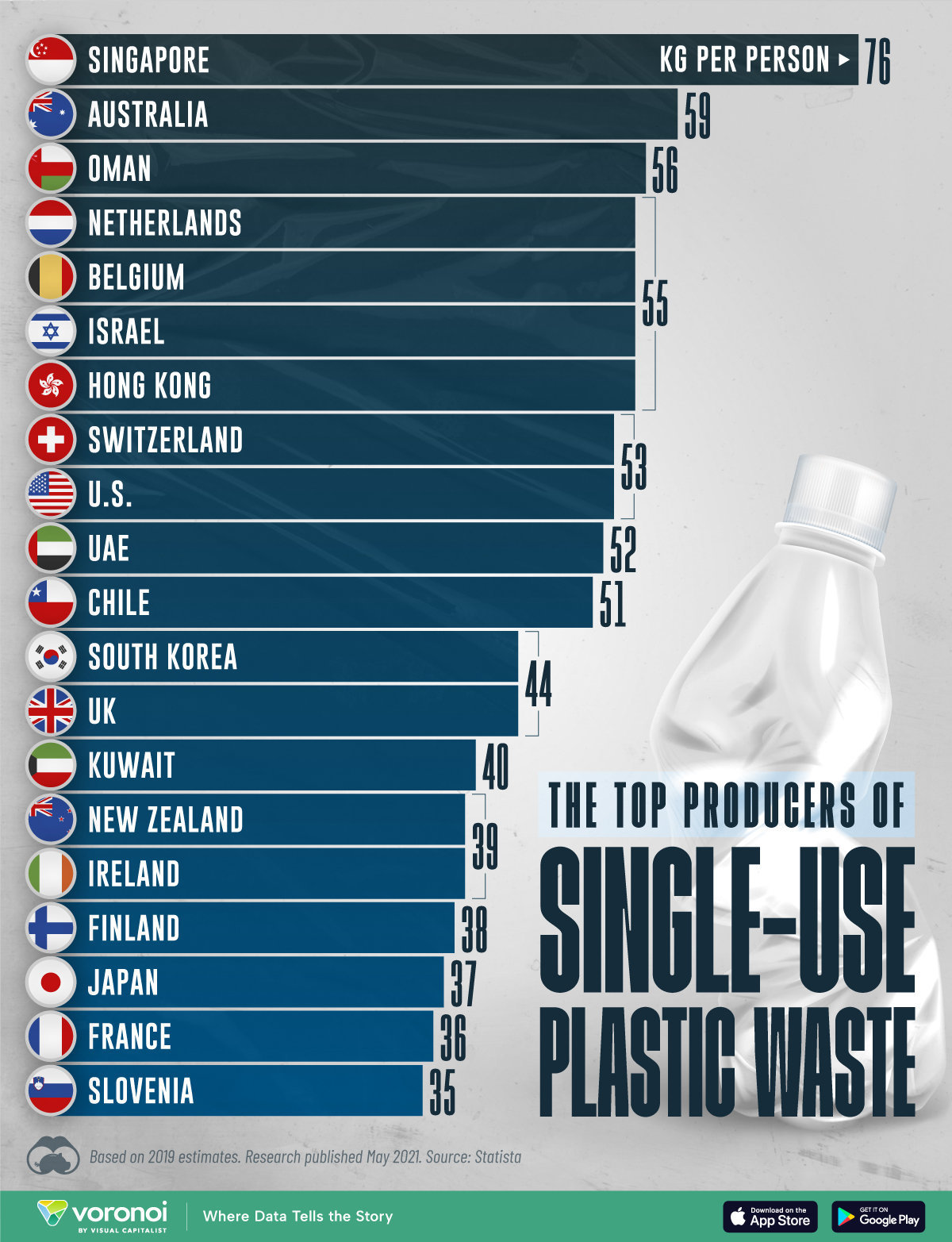
Graphic ranking countries by their plastic waste per capita

Single-use plastic waste is perhaps one of the biggest environmental issues of our time. Every year, millions of tons of plastic end up in oceans and landfills, harming wildlife and ecosystems.

To make matters worse, plastics take hundreds of years to decompose, leading to long-term environmental and health hazards as they break down into microplastics that contaminate water and food sources.

In this graphic, we visualized the top 20 countries that generated the most single-use plastic waste per capita in 2019, measured in kilograms per person. Figures come from research published in May 2021, which we sourced from Statista.

Data and Key Takeaways

The data we used to create this graphic is listed in the table below.

RankCountryKg per personPounds per person
1Singapore76168
2Australia59130
3Oman56123
4Netherlands55121
5Belgium55121
6Israel55121
7Hong Kong55121
8Switzerland53117
9U.S.53117
10UAE52115
11Chile51112
12S. Korea4497
13UK4497
14Kuwait4088
15New Zealand3986
16Ireland3986
17Finland3884
18Japan3782
19France3679
20Slovenia3577

Countries from all around the world are present in this ranking, highlighting how plastic waste isn’t concentrated in any one region.

It’s also interesting to note how most of the countries in this top 20 ranking are wealthier, more developed nations. These nations have higher levels of consumption, with greater access to packaged goods, take-out services, and disposable products, all of which rely on single-use plastics.

Where’s China and India?

Note that we’ve visualized plastic waste per capita, which is different from the total amount of waste produced by a country. It is for this reason that major polluters, such as China and India, are not present in this ranking.

It’s also worth noting that this focuses on the demand side of plastics, rather than where plastic products were initially created or produced.

If you’re interested to see more visuals on plastic waste, check out Which Countries Pollute the Most Ocean Plastic Waste?.
 

Friday, February 17, 2023

The Philippines 35%

Which Countries Pollute the Most Ocean Plastic Waste?

February 17, 2023

By Louis Lugas Wicaksono

Millions of metric tons of plastic are produced worldwide every year. While half of this plastic waste is recycled, incinerated, or discarded into landfills, a significant portion of what remains eventually ends up in our oceans.

In fact, many pieces of ocean plastic waste have come together to create a vortex of plastic waste thrice the size of France in the Pacific Ocean between California and Hawaii.

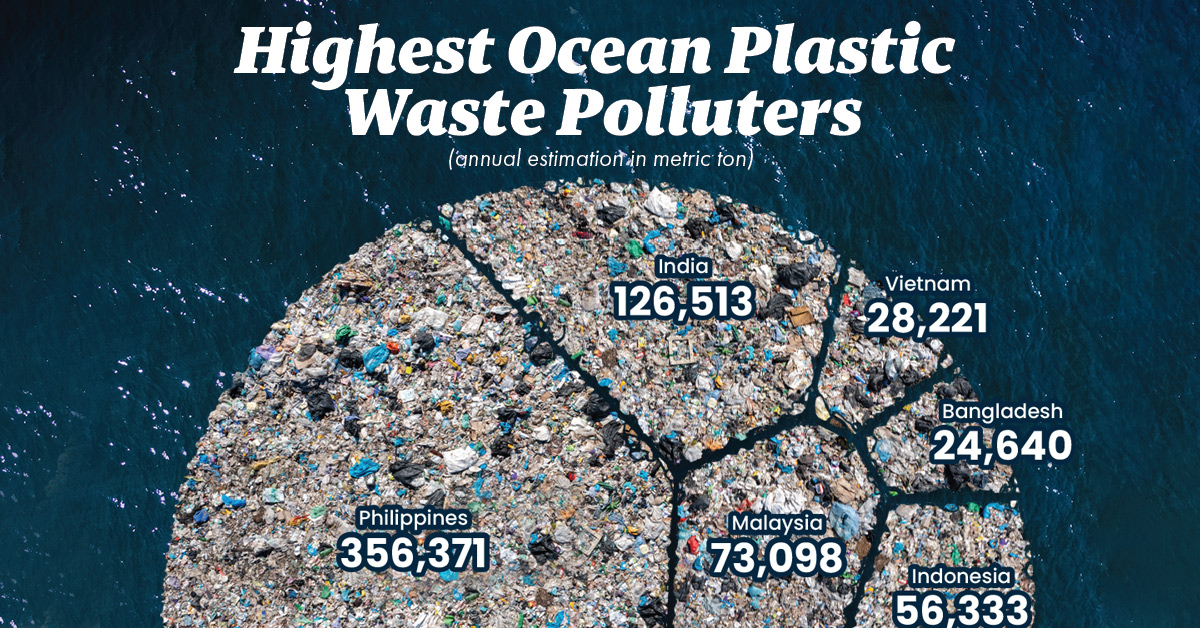
Where does all of this plastic come from? In this graphic, Louis Lugas Wicaksono used data from a research paper by Lourens J.J. Meijer and team to highlight the top 10 countries emitting plastic pollutants in the waters surrounding them.

Plastic’s Ocean Voyage

First, let’s talk about how this plastic waste reaches the oceans in the first place.

Most of the plastic waste found in the deep blue waters comes from the litter in parks, beaches, or along the storm drains lining our streets. These bits of plastic waste are carried into our drains, streams, and rivers by wind and rainwater runoff.

The rivers then turn into plastic superhighways, transporting the plastic to the oceans.

A large additional chunk of ocean plastic comes from damaged fishing nets or ghost nets that are directly discarded into the high seas.

Countries Feeding the Plastic Problem

Some might think that the countries producing or consuming the most plastic are the ones that pollute the oceans the most. But that’s not true.

According to the study, countries with a smaller geographical area, longer coastlines, high rainfall, and poor waste management systems are more likely to wash plastics into the sea.

For example, China generates 10 times the plastic waste that Malaysia does. However, 9% of Malaysia’s total plastic waste is estimated to reach the ocean, in comparison to China’s 0.6%.

RankCountryAnnual Ocean Plastic Waste (Metric tons)
#1Philippines356,371
#2India126,513
#3Malaysia 73,098
#4China 70,707
#5Indonesia56,333
#6Myanmar40,000
#7Brazil37,799
#8Vietnam28,221
#9Bangladesh 24,640
#10Thailand22,806
Rest of the World176,012
Total1,012,500

The Philippines—an archipelago of over 7,000 islands, with a 36,289 kilometer coastline and 4,820 plastic emitting rivers—is estimated to emit 35% of the ocean’s plastic.

In addition to the Philippines, over 75% of the accumulated plastic in the ocean is reported to come from the mismanaged waste in Asian countries including India, Malaysia, China, Indonesia, Myanmar, Vietnam, Bangladesh, and Thailand.

The only non-Asian country to make it to this top 10 list, with 1,240 rivers including the Amazon, is Brazil.

The Path to a Plastic-free Ocean

The first, and most obvious, way to reduce plastic accumulation is to reduce the use of plastic. Lesser production equals lesser waste.

The second step is managing the plastic waste generated, and this is where the challenge lies.

Many high-income countries generate high amounts of plastic waste, but are either better at processing it or exporting it to other countries. Meanwhile, many of the middle-income and low-income countries that both demand plastics and receive bulk exports have yet to develop the infrastructure needed to process it.

green check mark icon

This article was published as a part of Visual Capitalist's Creator Program, which features data-driven visuals from some of our favorite Creators around the world.

Thursday, December 19, 2019

Americans are using less water in their homes

Most water is used to generate electricity and crops.
Thermoelectric power, irrigation, public supply, industrial, aquaculture, mining, domestic, livestock

 
In U.S. more food going to waste

"If your actions inspire others to dream more, learn more, do more and become more, you are a leader." - John Quincy Adams