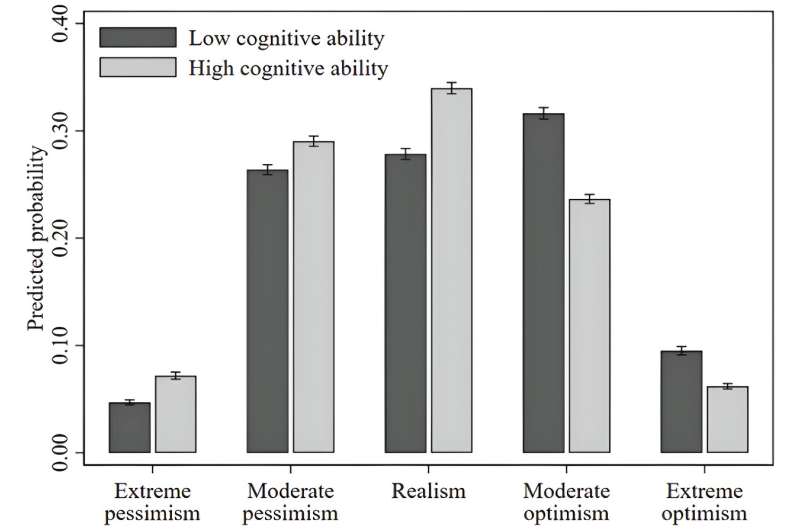
The Predicted Relationship Between Cognitive Ability and the 5-Point Unrealistic Optimism Scale—Sociodemographic, Socioeconomic and Educational Attainment Controls Included. Note. Bars (with 95% confidence intervals) represent the predicted probabilities of unrealistic optimism, for those high (+2 standard deviations from the mean) and low (−2 standard deviations from the mean) on cognitive ability. Credit: Personality and Social Psychology Bulletin (2023). DOI: 10.1177/01461672231209400
A behavioral economist at the University of Bath in the U.K. has found evidence linking higher levels of unwarranted financial optimism with lower levels of cognitive ability. In his study, published in the journal Personality and Social Psychology Bulletin, Chris Dawson surveyed thousands of people in the U.K. about their economic outlook and compared their responses with their true financial outlook.
Prior research has found links between a sunny outlook and better health and also a higher overall quality of life, including better relationships with people. But it has also shown that being overly optimistic can lead people to make poor decisions, such as how much to save for retirement. In this new study, Dawson looked for an association between unrealistic optimism and cognitive ability regarding financial decision-making.
Suspecting that people with lower cognitive abilities tended to overestimate their financial acumen, and thus make poor financial decisions, Dawson accessed the data repository of the Understanding Society project, which conducted a longitudinal survey involving more than 40,000 households in the U.K. and Northern Ireland over the years 2009 to 2021. He also analyzed data from the British Household Panel Survey run from 1991 to 2008.
The surveys queried respondents about their financial situation along with their expectations for the future. And because respondents were queried more than once over the course of the survey, Dawson was able to compare their earlier expectations with how things had actually panned out years later. Also included in the surveys were questions designed to assess several traits associated with cognitive ability, such as memory, word recall, verbal fluency, math ability and abstract thought.
By comparing the results from both parts of the surveys, Dawson was able to compare cognitive ability with financial optimism. In so doing, he found associations between the degree of optimism reported and cognitive ability. Those with higher cognitive abilities tended to be less optimistic, while the opposite was true for those who had lower cognitive abilities.
More specifically, he found that respondents scoring the highest on the cognitive tests were 22% more likely to fall into the category of realists, which Dawson describes as more objective about their financial prospects, than were those falling on the opposite end of the spectrum.
Many of us are taught to believe that we need to be in perfect control of our lives in order to be successful or accepted. But that mindset made me unhappy for years.
Growing up nonbinary, I spent a lot of time escaping to an imaginary world where I controlled everything, including what other people thought of me. I constantly chased this idea that if I could just get that boyfriend, that job, or that money and acclaim, I could finally relax and be happy.
To break this toxic mental habit, I did something drastic: I moved to the woods and lived amongst a community of Buddhists, and have since spent 20 years studying Zen Buddhism.
At the monastery, I learned a valuable lesson about happiness that people often overlook: We can’t control everything that happens to us, but we cancontrol how we treat ourselves. Allowing ourselves to feel happy, no matter what our life looks like, is the key to real happiness.
Why struggling for control won’t make you happier
When you hold on to the need for control, you start to feel responsible for all outcomes of your life. But can you really control what people think of you, or who does or doesn’t give you a chance, or who you’ll date, or where you’ll get a job?
You might have some say in these things, but so much of life is unpredictable — and that’s part of what makes it beautiful. Unpredictability connects us all.
Another problem with the need to control is that it makes you constantly chase after a life you aren’t living, making it hard to appreciate the one you already have.
For example, right now, you might be worried about about finding the perfect partner. In a few years, it might be finding the perfect job.
How to let go of the desire to control
If you free yourself from the need to control everything, you can experience more happiness and gratitude in the present.
Here are some ways to get started:
1. Stop and reflect.
Think about all the ways you’re focusing on an imaginary future instead of the present.
Ask yourself:
Do you sometimes let your need to control the future get in the way of you enjoying the present moment? When do you tend to do that, and why?
It is essential to honor your dreams, but how can you put some of that energy into the most important things in your life today?
What can you be grateful for right now?
2. Redefine unrealistic expectations you set for yourself.
Find that voice in your head that keeps reminding you of the need for control. Tell that voice, in no uncertain terms, that you are not living to impress it.
Can you imagine living a life where that inner voice is irrelevant? Instead, can you direct that energy towards something that will give you a sense of joy or peace?
3. Allow yourself to be happy in the present moment.
Close your eyes, take three slow breaths, and give yourself permission to feel happy.
If you find yourself struggling, think about why that is. I’ve found that when people think about giving up control and letting life guide them, fear can get in their way.
There will always be stressful situations that need your attention, like taking care of the people in your life. But you can let happiness in by shifting your focus from future-oriented fears to the present.
You deserve to roll with the life you’ve got. You deserve to flow with the unexpected and not “have it all together.”
But the bigger question isn’t about some cosmic meaning of life. It’s about how to find meaning in life. What makes life feel worthy and valuable to you?
For six years in a row, Finland has ranked No. 1 as the happiest country in the world. And having lived here my entire life, I’ve learned that finding meaning in life boils down to five words: Make yourself meaningful to others.
You can do this by opening yourself up to deep connections with both your community and your passions. Here’s how:
1. Live for yourself, not someone else’s expectations.
There tends to be less status anxiety in Finland because people aren’t so concerned about adhering to a rigid, societal definition of success.
It can be hard to live with purpose if you’re going through the motions, burned out, or filled with resentment because you’re on a path that someone else picked for you. Even a meaningful job like being a doctor can feel empty if your heart isn’t in it.
Before you can give to someone else, you have to understand what makes you happy, and start doing more of it.
2. Become an expert and share your knowledge.
One of the best ways to serve others is to find something that meets three requirements:
You’re good at it.
It excites you.
It has a positive impact on others.
Once you’ve found a job or a hobby that makes you feel fulfilled, put all your focus into becoming an expert in it. Then share it with your community.
3. Practice random acts of kindness.
In my courses on well-being, I encourage students to do three random acts of kindness a day. It can be as simple as offering a glass of water to the mailman, spending an afternoon with a grandparent, or helping a tourist find their way.
It’s incredibly uplifting to hear about the unexpected deep bonds that my students develop with others as a result.
Helping people doesn’t just feel good in the moment; it benefits your long-term health, too. Studies show that people who give emotional support to their family, friends and neighbors are more likely to live longer.
4. Be a good neighbor.
Talkoot is an old Finnish word that translates to “working together to do something that one would not be able to do alone.”
In agricultural times, when someone had a big project at their farm, such as building a barn roof, they’d hold a talkoot. Neighbors would gather voluntarily and put in a day’s work to help, then celebrate with food and drinks.
The tradition carries on to this day. Last summer, my neighborhood spent an afternoon planting trees. That evening, we set up tables and had a jolly evening with snacks and beverages.
This kind of culture extends to why Finnish people often feel positively about civic duties like paying taxes. They see it as essential for the good of the whole.
5. Embrace quiet time together.
People don’t need to make grand gestures to be an important part of your life. Being together in silence is enough to make us feel connected and loved.
For me, going to the sauna with my father or a friend, then silently sitting outside of it and watching nature — the waves of the sea crashing to the shore, the birds singing, the trees humming in the wind — are moments of deep meaning and connection.
As the Finnish saying goes: “Speech is silver, but silence is gold.”
While the role of motivation on the performance of behavioural tasks has been known for more than a century – thanks to the work of psychologists Robert Yerkes and John Dilligham Dodson – its precise effect on the brain remains unclear.
A team from the University of Geneva (UNIGE), in collaboration with the EPFL, has revealed how motivation alters the neural circuits responsible for sensory perception preceding decision-making in mice.
This study reveals why a level of motivation that is too high or too low can affect our perception and therefore our choices.
These results, featured in the journal Neuron, open up new perspectives in learning methods.
Going to work early in the morning, choosing a restaurant at lunchtime: many of our decisions are motivated by needs, such as earning a living or satisfying our hunger.
However, decision-making is a complex process, which can also be influenced by external factors, such as the environment or other individuals, and by our internal states, such as our mood, our level of attention or our degree of motivation.
The laboratory of Sami El-Boustani, Assistant Professor in the Department of Basic Neurosciences at the Faculty of Medicine of the UNIGE and recipient of an Eccellenza fellowship (SNSF), is studying the neural circuits involved in decision-making. In recent work, carried out in collaboration with Professor Carl Petersen’s team at EPFL, his lab has studied the role played by a specific internal state – motivation – in perception and decision-making.
For more than a century it has been known that a relationship between motivation and performance exists thanks to the work of American psychologists Robert Yerkes and John Dilligham Dodson. Too much or too little motivation is detrimental to performance. However, the way in which this impacts our neural circuits remains unclear.
‘‘We wanted to observe how sensory information transmitted by neurons in the cortex is altered by the degree of motivation and to what extent the latter can have an effect on learning and performance in a decision-making task,’’ explains Sami El-Boustani, the lead author of the study.
The research team developed a behavioral paradigm involving mice in a controlled water consumption regime. They first trained these rodents to respond to tactile stimuli via two whiskers (A and B) and to produce an action – licking a spout – only for whisker A in order to obtain a drop of water.
Following this training, these mice reacted mainly to the stimulation of whisker A, thus indicating their ability to discriminate between these two sensations. Finally, the researchers conducted these experiments at decreasing levels of thirst in order to vary the motivation of the rodents to participate in the task.
State of hyper-motivation blurs sensory information
In a state of great thirst – therefore of great motivation – rodents performed poorly. They licked the spout indiscriminately, without distinguishing between the whiskers stimulated.
In contrast, in a state of moderate thirst, the choice of their action became optimal. They mainly licked the spout when whisker A was stimulated. Finally, when they were not very thirsty, their performance in the task dropped again.
By observing the activity of neuronal populations responsible for perceptual decision-making in these mice, the researchers discovered that neurons in these circuits were flooded with electrical signals when mice were hyper-motivated. Conversely, in a state of low-motivation, the signals were too weak.As a result, the perception of the stimuli was also impaired. Image is in the public domain
‘‘Hyper-motivation leads to strong stimulation of cortical neurons, which causes a loss of precision in the perception of tactile stimuli,’’ says Giulio Matteucci, a Postdoctoral Fellow in Sami El-Boustani’s laboratory and the study’s first author.
In contrast, in the low-motivation state, the accuracy of the sensory information was recovered, but the strength of the signal was too low for it to be transferred correctly. As a result, the perception of the stimuli was also impaired.
A new understanding of learning
These results open up new perspectives. They provide a possible neural basis for the Yerkes-Dodson Law.
‘‘They also reveal that the level of motivation does not only impact decision-making but also the perception of sensory information, which leads to the decision’’, explains Carl Petersen, Full Professor at the Brain Mind Institute of EPFL and co-senior author in the study.
This work also suggests that it is necessary to decouple acquisition and expression of new knowledge.
‘‘We observed that mice understood the rule very quickly but could only express this learning much later, depending on an altered perception linked to their level of motivation.’’
This unraveling of the role of motivation in learning opens the way to new adaptive methods that aim to maintain an optimal level of motivation during learning.
About this neuroscience and decision-making research news
Author: Antoine Guenot Source: University of Geneva Contact: Antoine Guenot – University of Geneva Image: The image is in the public domain
A new study contradicts a 1979 study that found that the students who weren’t depressed overestimated their own level of control over a light turning green when they pushed a button. Photo by pasja1000/Pixabay
Some people believe in the idea of "depressive realism" -- that depressed people are just more realistic than others about how much they control their lives. But a new study upends that theory.
The idea has been around for about four decades, ever since a 1979 study of college students that seemed to support the theory.
That study looked at whether students could predict how much control they would have over a light turning green when they pushed a button. The researchers back then found that students who weren't depressed overestimated their own level of control and that depressed students were better at identifying when they had no control over the lights.
In the current study, researchers tried to replicate those findings but were unable to do so.
The original depressive realism study is cited more than 2,000 times in later studies or research. It is infused into science, culture and potential mental health treatment policy, said study co-author Don Moore. He's chair of leadership and communication at the University of California, Berkeley School of Business.
The study's widespread acceptance in both the scholarly and popular literature is a reason to revisit it, Moore said. That means a lot of people are building theories or policies with the belief that this is true, making it important to know if it is or not. (For more on research into depressive realism, click here.)
Researchers in the new study worked with two groups of participants. The first group included 248 people from Amazon's Mechanical Turk, an online service that provides paid survey-takers. The other group of 134 volunteers were college students who participated in return for college credit.
Similar to the 1979 study, participants did a task with 40 rounds, each choosing whether to press a button, after which a lightbulb or a black box appeared.
Participants had to figure out whether pushing or not pushing the button affected whether the light came on. They reported how much control they had over the light after each of the rounds.
The researchers added a mechanism to measure bias to the original study measurements. They also experimentally varied the amount of control participants actually had over the light.
People in the online group with a higher level of depression overestimated their control, which directly contradicts the original study.That finding may be driven by anxiety rather than depression, the researchers said. This merits further study, Moore noted in a university news release.
In the student group, depression levels had little impact on how the students viewed their control.
Depression also had no impact on overconfidence when asking study participants to estimate their scores on an intelligence test, the investigators found.
Moore said the results of this new study undermined his belief in depressive realism. He added that the study does not suggest that there are benefits to being depressed.
How to accurately gauge a person's level of control in various situations does have broader implications in life, Moore said. To make good choices, it can be helpful to know what people do and don't control.
The findings were published online recently in the journal Collabra: Psychology.